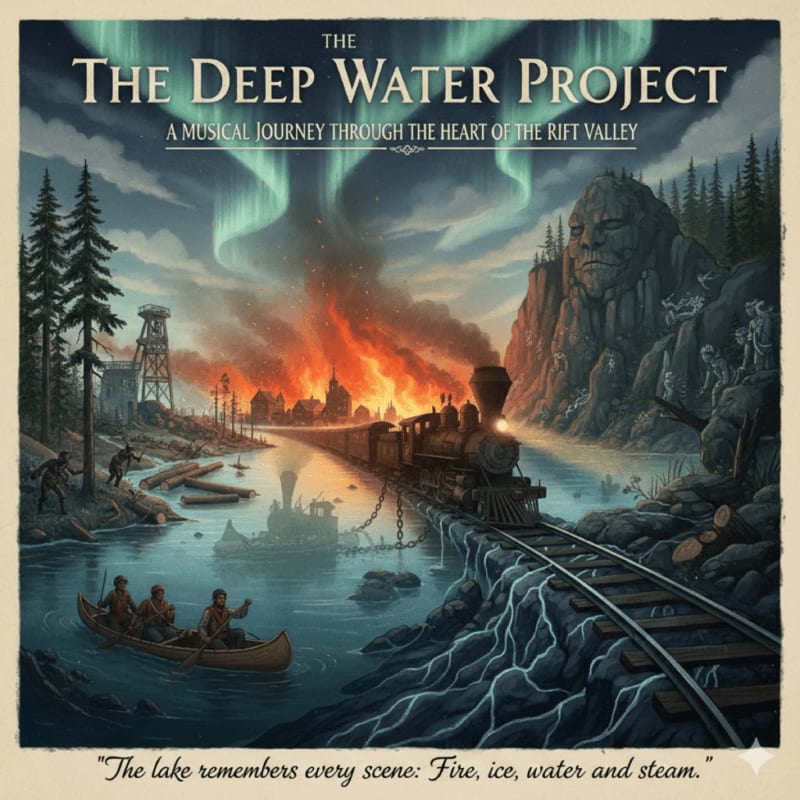
There Are Stories Hidden All Across This Region — The Deep Water Project Wants People to Hear Them.
There are stories all across this region.
Stories buried in old mines.
Stories sitting quietly inside museums people keep meaning to visit someday.
Stories hidden in lakes, logging roads, train tracks, fires, hockey arenas, and communities that somehow kept rebuilding themselves every time life here became difficult.
Most people just never stop long enough to hear them.
That realization slowly became one of the foundations behind the Deep Water Project, an ambitious live musical production coming to the Classic Theatre.
What started as a single song eventually became something much larger. Not just a concert. Not just a history lesson. But an attempt to capture the identity of the Temiskaming region itself through music, storytelling, narration, and the voices of local musicians who live here.
And the deeper Roy Dittmann dug into local history, the more he realized how much had never really been told.
“There’s just so much rich history here. Every time we researched something, another story opened up.”
- Roy Dittmann, Creator of the Deep Water Project
From One Song to Twelve
Back in October, Roy and his wife Erica attended one of Charlie Angus’s storytelling performances. During the show, Angus talked about how songs and music can preserve the stories of people and places. That idea stayed with Roy.
At first, he thought maybe he would write a single song inspired by the Temiskaming region. But once the research started, it became difficult to stop. One topic led to another. Then another.
Soon the project expanded into twelve original songs exploring different parts of local history.
"There were more songs too," Roy admitted. "We just had to narrow it down into a logical show."
The Resilience That Defines This Place
As Roy researched the region’s past, one theme kept surfacing repeatedly: endurance.
"The resilience of the people here is probably what makes this region unique," he said. Communities here have survived mining collapses, economic uncertainty, harsh winters, devastating fires, and constant reinvention.
The Haileybury fire alone became one of the emotional centrepieces of the production.
"I knew there was a big fire," musician Nathaniel Preston explained. "But when you really hear the stories and read the lyrics, you realize how massive it actually was."
That reaction became common during rehearsals. The deeper people went into the stories behind the songs, the more the region itself started feeling different.
“There is something deeply human about communities that continue rebuilding themselves over and over again.”
- Roy Dittmann
A Gateway, Not Just a Show
Roy repeatedly described the production as "a gateway." Not simply an evening of entertainment. A doorway. He hopes audiences leave the theatre wanting to explore the stories behind the songs for themselves.
The museums. The landmarks. The forgotten histories scattered throughout Temiskaming Shores, Cobalt, Haileybury, and the surrounding area.
"I think after seeing the show, people will understand the region differently," Roy said. "Things will mean more."
This production is not trying to tell audiences everything. It is trying to awaken curiosity.
"There's history everywhere here," Roy said. "People just don't always realize it."
Telling Stories Responsibly
As the project expanded, Roy realized certain topics needed to be approached carefully and respectfully. That became especially important when Indigenous stories and teachings entered the songwriting process."
I didn't feel comfortable writing material about something I'm not part of," Roy explained. That decision led to the involvement of Temagami musician David Laronde, who helped shape portions connected to Indigenous history and teachings.
That collaboration helped ground the production in lived experience rather than simply outside interpretation. Those sections became some of the most meaningful parts of the show.
Built From Within the Community
What makes the Deep Water Project even more unique is how collaborative it became. Roy brought together musicians from across the region, each adding their own personality, style, and musical strengths.
Musician Nathaniel Preston said the experience felt very different from his usual projects. This time, he stepped into somebody else's vision.
"It's different for me," he explained. "I'm playing the part rather than writing the part." But even early on, he sensed the project was becoming something unusual.
"You work on something and work on something," Nathaniel said. "Then suddenly there's a take where everybody gets excited because you know that was the one”.
Julie Preston said one of the most rewarding parts of the project was seeing local musicians come together in ways they normally wouldn't. "It strengthened the community a little bit," she said.
Music That Shifts With Each Story
The music itself constantly shifts depending on the story being told. A song inspired by voyageurs traveling by canoe carries French Canadian musical influences. Another inspired by the Haileybury fire takes on a far heavier, more aggressive sound.
"That one's almost metal," Julie laughed.
Different songs feature different vocalists, instrumentation, and moods. At various moments, audiences will hear fiddles, spoons, hand drums, mandolins, tin flutes, layered harmonies, and multiple singers stepping forward depending on the story unfolding.
"They really tried to give each song its own personality," Julie explained.
“There’s history here that’s hard to really learn unless somebody tells it.”
- Nathaniel Preston, Musician
A Region Reawakening
Throughout our conversations, another theme kept surfacing: community vibrancy. The feeling that something has been slowly reawakening in Northern Ontario over the past few years.
"There's been almost a bit of a renaissance since COVID," Nathaniel said. "People want to get out and do things again."
And perhaps that is part of why the Deep Water Project seems to be resonating. Because it feels local in the deepest sense of the word. Built from within by people who know these roads, these lakes, these stories, these winters, these losses, these communities.
And maybe audiences are hungry for that kind of authenticity right now. Not just entertainment. Connection.
As our conversation wrapped up, I asked Roy what he hoped people would feel walking out of the theatre after the final song ended.
He paused for a moment before answering.
"Pride," he said.
"And a desire to go learn more."
Maybe that is ultimately what the Deep Water Project is trying to do. Not simply retell history. But reconnect people to place. To remind audiences that this region contains far more story, culture, struggle, creativity, and identity than many people realize.
The Deep Water Project will be performed at the Classic Theatre. And if the growing interest is any indication, tickets may not last much longer.
The Deep Water Project
An original live musical production exploring the stories, history, and identity of the Temiskaming region — performed at the Classic Theatre.
Get Your Tickets